
Rising fuel prices and carrier rate increases are not temporary disruptions - they are structural pressures that continue to compound across supply chains. For warehouse and distribution operations, shipping is no longer a downstream expense. It is a primary driver of margin erosion.
The problem is not just cost per shipment. It is inefficiency across labeling, picking, packing, and verification that quietly multiplies those costs at scale.
This is where AIDC - automatic identification and data capture - shifts from operational support to financial control.
Shipping Costs Are No Longer Isolated - They Are Systemic
Most organizations look at shipping costs through the lens of carrier contracts or negotiated rates. That is only part of the equation.
The real exposure comes from operational friction:
- Incorrect labels leading to re-shipments
- Mis-picks resulting in returns and replacement shipments
- Inefficient cartonization increasing dimensional weight charges
- Manual processes slowing throughput and increasing labor per shipment
Each of these issues compounds the impact of rising fuel surcharges. A 5–10% increase in freight rates can translate into a 15–25% increase in total shipping-related costs when operational inefficiencies are present.
AIDC systems address this at the source - where errors originate.
Label Accuracy Directly Impacts Freight Spend
Labeling is often treated as a commodity function. In reality, it is one of the most critical control points in the shipping process.
Poor label quality or incorrect data results in:
- Carrier rejections and delays
- Manual relabeling and labor costs
- Chargebacks and compliance penalties
- Lost packages and duplicate shipments
High-performance thermal printers, paired with validated barcode verification workflows, eliminate these risks.
More importantly, standardized labeling ensures:
- Accurate routing on the first scan
- Reduced exception handling
- Faster dock-to-departure times
In a high-cost shipping environment, every avoided exception is a direct cost savings.
Real-Time Data Eliminates Costly Decision Lag
Warehouse operations often operate with delayed or incomplete data. That delay creates inefficiencies that directly impact shipping costs.
AIDC-enabled workflows change that dynamic:
- Mobile computers provide real-time inventory visibility
- Barcode scanning enforces pick accuracy at the point of action
- Integrated systems ensure shipping decisions are based on current data
This enables:
- Smarter carrier selection based on actual order profiles
- Optimized packaging decisions to reduce dimensional weight
- Reduced split shipments due to inventory inaccuracies
Without real-time data, operations default to conservative - and more expensive - decisions.
Labor Efficiency Is a Hidden Shipping Multiplier
Labor and shipping are tightly connected, even if they are accounted for separately.
Every additional touchpoint in the warehouse increases:
- Time per order
- Cost per shipment
- Risk of error
AIDC reduces touches by enforcing process discipline:
- Scan-based picking eliminates verification steps later in the process
- Automated label generation reduces manual entry errors
- Guided workflows reduce training time and variability
The result is not just faster operations. It is a lower cost per shipment, even before freight charges are applied.
Returns and Re-Shipments Are the Most Expensive Shipments You Make
The most expensive shipment is the one you have to send twice.
Returns driven by operational errors create a cascade of costs:
- Outbound freight
- Inbound freight
- Labor to process returns
- Replacement shipment costs
- Customer experience impact
AIDC systems reduce these errors at their origin:
- Scan validation ensures correct item selection
- Serialized tracking improves traceability
- Integrated workflows reduce data mismatches
Reducing return rates by even a small percentage has an outsized impact on total shipping spend.
Standardization Is the Lever Most Operations Ignore
Many warehouses operate with fragmented processes:
- Different labeling standards across facilities
- Inconsistent hardware and software environments
- Varying levels of process enforcement
This inconsistency creates variability in cost.
Standardizing on AIDC-driven workflows delivers:
- Predictable performance across locations
- Easier scaling during peak periods
- Reduced training and onboarding time
- Consistent shipping accuracy
Standardization is not just operational discipline - it is cost control at scale.
Conclusion
Rising fuel and shipping costs are not a problem you can negotiate away. They are a constraint that requires operational precision to overcome.
AIDC is not just about scanning barcodes or printing labels. It is about eliminating the friction that amplifies shipping costs across your operation.
The organizations that treat AIDC as a strategic investment - not a tactical tool - are the ones that will protect margins, maintain service levels, and stay competitive as shipping costs continue to rise.
Recent Posts
Apr 6th 2026
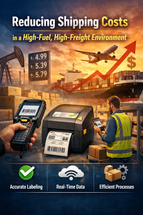
Reducing Shipping Costs in a High-Fuel, High-Freight Environment - Why AIDC Strategy Matters More Than Ever
Mar 23rd 2026
Don’t Waste Q2: The Most Underrated Quarter in AIDC and Warehouse Operations
Mar 9th 2026