
A Hard-Use Comparison for Industrial Labeling Environments
In industrial labeling, printers are not office peripherals. They are production equipment. Whether installed on a packaging line, embedded into an automated system, or running 24/7 in a distribution center, the printer has one job: print accurately, consistently, and without interruption.
Two brands dominate these conversations - SATO and Zebra Technologies. Both are respected. Both are widely deployed. But when the evaluation shifts from feature lists to long-term durability, mechanical design, and total cost of ownership, SATO consistently separates itself as the more industrial-first platform.
This paper examines where SATO printers and print engines deliver measurable advantages over Zebra in hard-use environments.
Design Philosophy: Industrial Machinery vs Enterprise Hardware
Zebra printers evolved from enterprise and logistics workflows - flexible platforms designed to cover many use cases with configurable options.
SATO printers were engineered from the start as industrial machinery.
That distinction matters.
SATO frames, drive systems, and print mechanisms are designed to run continuously in manufacturing and packaging environments where vibration, dust, temperature swings, and high-duty cycles are normal operating conditions. Zebra printers perform well in many warehouse environments, but they are often optimized for throughput and feature density rather than mechanical overbuild.
In short:
- Zebra focuses on adaptability across environments
- SATO focuses on survivability inside production environments
Mechanical Hardiness and Build Quality
One of the most noticeable differences between SATO and Zebra appears once the cover is open.
SATO printers and print engines typically feature:
- Heavier-gauge metal frames
- Direct-drive motor systems
- Precision media and ribbon paths designed to reduce skew and wear
- Fewer plastic structural components in high-stress areas
This translates to: - Better media tracking at high speeds
- Fewer ribbon wrinkles and head strikes
- Reduced calibration drift over time
Zebra printers are well-engineered, but many models rely more heavily on composite components and modular assemblies. In demanding environments, those designs can require more frequent adjustment and part replacement.
Print Engines: Purpose-Built for Automation
When it comes to print engines, the difference becomes even more pronounced.
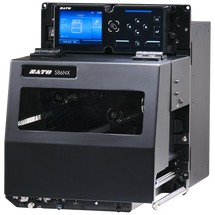
SATO print engines are designed to be embedded. Not adapted.
They are built specifically for:
- Packaging machinery
- Weigh-price labeling systems
- Print-and-apply applications
- High-speed automated lines
Key advantages of SATO print engines include: - Compact, rigid designs that tolerate vibration
- Consistent print placement at speed
- Industrial I/O architectures that integrate cleanly with PLCs
- Long service intervals even in harsh conditions
Zebra print engines are widely deployed and supported, but many originate from modified printer platforms rather than ground-up industrial engine designs. In high-speed automation, consistency and mechanical rigidity matter more than UI features.
Media Handling and Print Accuracy
Label quality is not just about DPI. It is about repeatability.
SATO printers are known for exceptionally precise media handling, especially with:
- Small labels
- Dense barcodes
- Compliance labeling
- High-speed print-and-apply systems
This precision reduces: - Reprints
- Scanner failures
- Label waste
- Line stoppages
Zebra printers can deliver excellent print quality, but they often require tighter media tolerances and more frequent calibration in comparison.
Total Cost of Ownership
Initial purchase price rarely tells the full story.
Over time, SATO printers tend to deliver:
- Longer service life
- Fewer mechanical failures
- Reduced unplanned downtime
- Lower intervention from maintenance teams
Zebra’s advantage is ecosystem scale - wide availability, strong software integration, and familiarity for IT teams. However, in production environments where downtime costs outweigh hardware costs, SATO’s mechanical durability often results in a lower true cost of ownership.
Software and Control: Different Strengths
Zebra excels in:
- Enterprise device management
- Broad software compatibility
- Unified fleets across scanners, mobile computers, and printers
SATO excels in: - Deterministic printer behavior
- Predictable control in automation
- Application-specific firmware stability
For operations running ERP-driven print jobs across large device fleets, Zebra is a natural fit. For operations where the printer is part of a machine, SATO’s focused approach is often the safer choice.
When SATO Is the Better Choice
SATO printers and print engines consistently outperform when:
- Printers run continuously, not intermittently
- The environment is harsh or vibration-prone
- Print accuracy must remain stable at speed
- Downtime is unacceptable
- The printer is embedded into automation
Zebra remains a strong solution for mixed enterprise environments, but SATO shines where printers are treated as industrial assets, not IT endpoints.
Final Perspective
Recent Posts
Mar 23rd 2026
Don’t Waste Q2: The Most Underrated Quarter in AIDC and Warehouse Operations
Mar 9th 2026
Why Label Failures Cost More Than You Think: 7 Hidden Expenses Ops Teams Overlook
Feb 3rd 2026