
Industrial barcode scanning asks a lot from a relatively small piece of technology. On a manufacturing floor, a scanner may need to capture a clean printed barcode one minute and a difficult Direct Part Mark (DPM) the next. Barcodes can appear on reflective materials, curved components, challenging backgrounds, or surfaces where contrast is far from ideal. At the same time, the scanner itself needs to stand up to the realities of an industrial environment.
Newland AIDC designs its industrial handheld scanning technology around these challenges. Its approach combines industrial decoding technology, intelligent scanning capabilities, specialized illumination, DPM decoding, rugged construction, and industrial connectivity.
Rather than treating industrial scanning as simply a more durable version of everyday barcode capture, Newland focuses on the complete scanning application: the barcode, the surface, the environment, the operator, and the system receiving the data.
The goal is simple: make difficult barcode capture easier and more reliable in the environments where scanning performance matters most.
Newland Starts With the Most Important Part: Capturing the Barcode
A scanner can have an impressive list of specifications, but none of them matter if the device struggles with the barcodes an operation actually needs to capture.
That becomes especially important in industrial environments, where barcode quality and scanning conditions can vary considerably. Along with traditional 1D and 2D barcodes, manufacturers may use Direct Part Marking (DPM) to permanently identify components through methods such as laser etching and dot peening.
Newland has developed its industrial scanning technology with these more complex applications in mind. Its industrial handheld solutions incorporate decoding technology designed to handle challenging barcodes, including DPM applications.
The NVH220, for example, combines Newland's industrial decoding technology with intelligent capabilities designed to improve performance across challenging scanning scenarios.
For the operator, all of that technology serves a much simpler purpose: spend less time fighting with the barcode and more time moving through the job.
Newland Uses Illumination to Take On Difficult Materials and Surfaces
Decoding technology is only one part of successful industrial scanning. The scanner first needs to get a usable view of the barcode.
That can become difficult when the barcode is located on reflective metal, a curved component, an unusual background, or a material that reacts differently to light.
Think about looking at an engraving on a polished metal surface. From one angle, glare can make the marking difficult to see. Change the lighting, and suddenly the detail becomes much clearer.
Newland addresses this challenge with advanced illumination technology within its industrial handheld scanner portfolio. Different forms of illumination can help accommodate variations in material, reflection, surface shape, background, and barcode color.
This is one of the areas where a scanner such as the NVH220 demonstrates Newland's approach, combining multiple illumination options with its industrial decoding capabilities to address difficult barcode and DPM applications.
Instead of assuming every code will be printed in black on a clean, flat, white label, Newland designs its industrial scanning technology around the more complicated conditions found in real applications.
In manufacturing, that flexibility matters because the production environment cannot always be changed to make life easier for the scanner.
The scanner needs to be designed for the production environment.
Newland Is Bringing Intelligence Into the Scan
One of the more interesting parts of Newland's approach to industrial scanning is what happens behind the trigger pull.
Within its industrial handheld portfolio, Newland incorporates technologies such as AI-powered barcode positioning and intelligent learning to improve performance across challenging scanning scenarios.
That is important because industrial barcode capture is rarely static. An operator may encounter different materials, barcode conditions, surfaces, and lighting situations throughout the same operation.
Instead of thinking about industrial scanning only in terms of raw scanning speed, it is useful to think about how efficiently the scanner can arrive at a successful read.
Every unnecessary trigger pull, repositioning attempt, or manual entry introduces a small interruption into the workflow. One difficult scan might not seem significant. Multiply those interruptions across hundreds or thousands of scans, multiple employees, and multiple shifts, and small inefficiencies can become much more noticeable.
Newland's combination of industrial decoding and intelligent scanning technology is ultimately about making the scanning process more consistent when the application itself is not.
Newland Builds Industrial Scanners for Industrial Environments
Newland's approach does not stop once the barcode has been decoded.
Industrial scanners also need to survive where they are being used.
Manufacturing and logistics environments can expose equipment to drops, dust, repeated handling, and demanding operating conditions. A scanner might spend its day moving between workstations, sitting on a production bench, traveling around a pallet, or being used continuously throughout a shift.
Newland's industrial handheld portfolio is designed with rugged construction and environmental protection in mind. Across the portfolio, Newland incorporates features such as environmental sealing and drop resistance to support use in demanding environments.
The NVH300 Series, for example, demonstrates that emphasis on ruggedness with an industrial design built for demanding barcode capture environments.
Those features are about more than protecting the scanner itself.
When a scanning device goes down, the impact can extend to the process around it. An operator may need replacement equipment, a workstation can be interrupted, or IT and maintenance resources may need to become involved.
Newland's rugged industrial design helps address that risk by building durability into the scanning solution from the beginning.
In an industrial application, ruggedness isn't separate from performance. It is part of performance.
Newland Gives Operations Flexibility in How Scanning Gets Done
A scanner also has to fit the way employees actually work.
For some operations, the scanner remains at a dedicated workstation. A corded connection can provide a straightforward solution when the operator and the product consistently come together at the same location.
Other workflows require considerably more movement. An employee might need to move around a pallet, inspect a large component, travel between workstations, or scan items that cannot easily be brought to a fixed location.
Newland's industrial handheld portfolio provides both corded and cordless approaches, allowing the scanning technology to better match the physical workflow.
For applications requiring greater mobility, the NVH220B is one example of how Newland brings industrial barcode capture into a cordless platform. Newland also offers industrial interface and communication options across its portfolio to help captured barcode data reach the systems and equipment that need it.
This matters because reading the barcode is only the first half of the job. Once captured, that information has to become useful somewhere else in the operation.
The objective should not be to redesign a good workflow around the limitations of a scanner.
The scanner should fit the workflow.
Newland's Technology Addresses the Entire Scanning Application
What makes industrial barcode scanning complicated is that there is rarely one variable responsible for success or failure.
The barcode matters.
The marking method matters.
The surface matters.
Lighting matters.
The environment matters.
Connectivity matters.
And the way the operator interacts with the device matters.
This is why Newland's industrial scanning portfolio brings multiple technologies together rather than relying on any single feature. Industrial decoding helps tackle difficult barcode data. DPM capabilities address permanently marked components. Advanced illumination helps with challenging materials and surfaces. Intelligent scanning technology helps address changing scenarios. Rugged construction supports demanding environments. Corded, cordless, and industrial interface options help the technology fit different workflows.
Products within Newland's industrial portfolio, including the NVH220 family and NVH300 Series, demonstrate different combinations of these capabilities depending on the application.
Each capability solves a different piece of the same problem: capturing the right information reliably without creating unnecessary friction for the operator.
Why the Application Should Still Come First
Even with all of these capabilities, choosing an industrial scanner should never start and end with a specification sheet.
The better starting point is the application.
What type of barcode is being scanned? Is it printed on a label or marked directly onto the component? What material is underneath it? Is the surface flat, curved, reflective, or textured? Is the barcode high-density or low-contrast? How will employees physically interact with the scanner? Does the application require mobility? What system needs to receive the captured data? And what kind of environment will the device experience every day?
These questions help determine which Newland scanning capabilities actually matter for the application.
Whenever possible, an industrial scanning solution should also be evaluated against the real application. A perfect demonstration barcode can show that a scanner works. The actual barcode, material, and scanning conditions show whether it works for your operation.
That distinction is important.
Making Industrial Scanning the Part Nobody Has to Think About
Newland's industrial handheld scanning technology is built around an idea that sounds simple but can be difficult to achieve in practice: reliable data capture in demanding environments.
Advanced decoding technology helps tackle difficult barcodes and DPM applications. Intelligent scanning capabilities help address challenging scenarios. Specialized illumination helps accommodate variations in surfaces and materials. Rugged construction helps devices withstand industrial use. Flexible connectivity helps integrate scanning into the workflow.
Individually, those are product features.
Together, they serve a much larger purpose.
An operator should not have to think about the technology behind every trigger pull. They should not have to repeatedly change angles, reposition components, or stop their workflow because a difficult barcode will not read.
They should scan and keep moving.
That is where Newland's approach to industrial handheld scanning comes together: technology designed not simply to read a barcode, but to make reliable data capture a natural part of the operation.
Because when hundreds or thousands of scans happen every day, the best scanning technology is often the technology your operators don't have to think about.
Recent Posts
Sep 30th 2026
POSTEK Industrial Printers Now Available at the Ganson Store
Sep 17th 2026
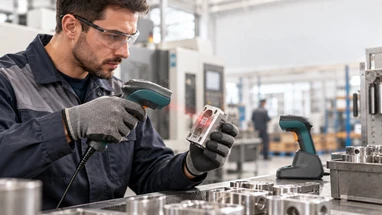
Built for the Real World: Inside Newland’s Approach to Industrial Barcode Scanning
Sep 14th 2026